-
- -
-

Introduction: A Snacking Revolution Is Underway
The global snacking industry has entered a new era one defined not by indulgence alone, but by nutrition, functionality, and conscious consumption. At the heart of this transformation sits the Protein Bars Market, a segment that has evolved from a niche fitness supplement into a mainstream dietary staple. As consumers across the world grow increasingly healthaware, protein bars have cemented their status as the goto snack for athletes, busy professionals, weightconscious individuals, and everyone in between. What was once a modest shelf in a gym store is now a thriving global market, forecasted to nearly double in value over the next decade.
Market Overview: Numbers That Tell a Powerful Story
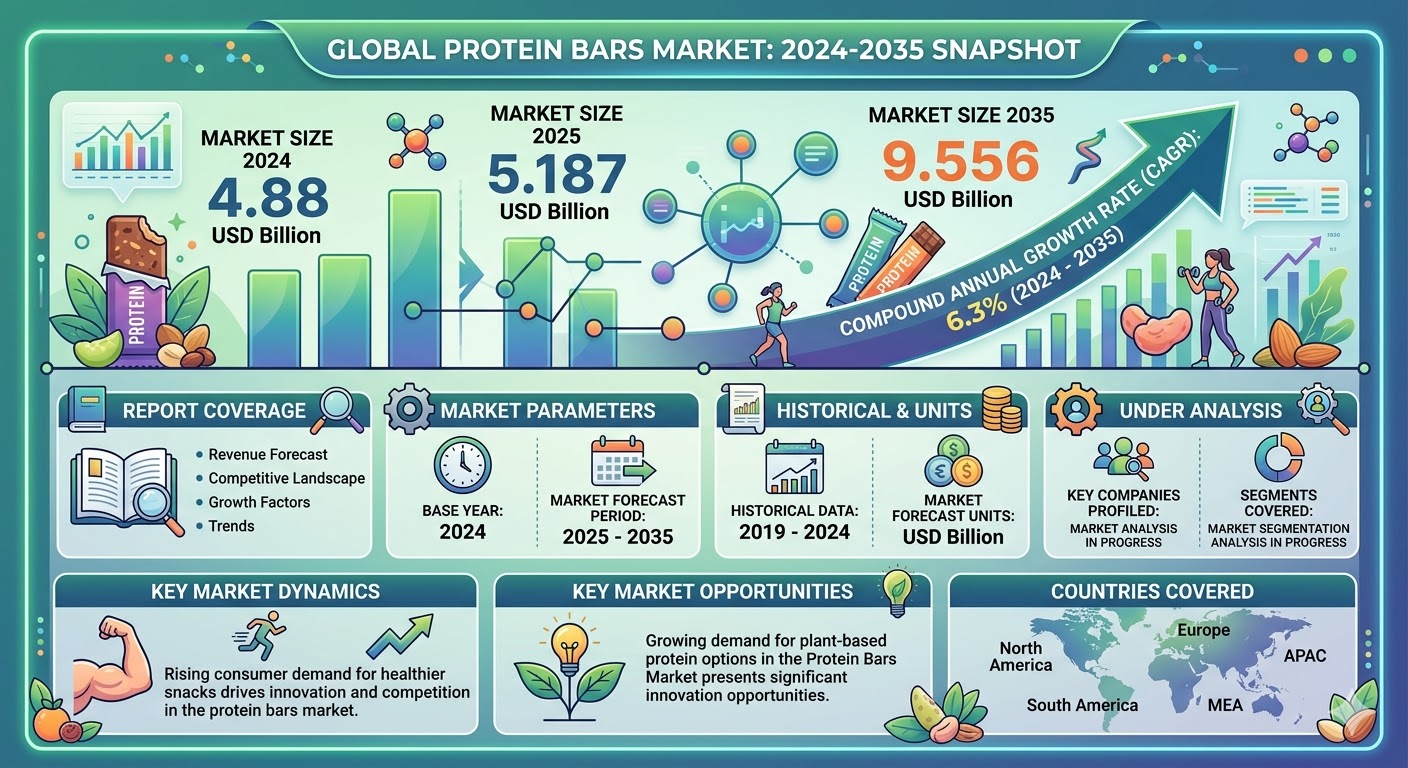
Market Size in 2024: The Protein Bars Market was valued at USD 4.88 Billion in the base year of 2024, reflecting a robust and alreadymature industry with significant momentum.
→ This valuation confirms that protein bars are no longer a supplementary product they are a mainstream consumer staple.
→ Historical data from 2019 to 2024 reveals a consistent upward trajectory, signaling sustained consumer adoption over the past five years.
Market Size in 2025: The market is projected to reach USD 5.187 Billion in 2025, marking a notable yearoveryear growth from the 2024 baseline.
→ This increase is being driven by expanding retail channels, growing fitness culture, and increased internet penetration enabling ecommerce sales.
Market Size by 2035: By the end of the forecast period, the market is expected to soar to USD 9.556 Billion nearly doubling its 2024 value.
→ This projection underscores the long-term structural growth of the health and wellness food segment globally.
Compound Annual Growth Rate (CAGR): The market is projected to grow at a CAGR of 6.3% from 2024 to 2035, reflecting strong and consistent demand acceleration.
→ A 6.3% CAGR places the Protein Bars Market among the fastest growing segments in the global packaged food industry.
Key Growth Factors: What Is Fueling the Surge?
Rising Consumer Demand for Healthier Snacks: One of the most powerful forces propelling the Protein Bars Market forward is the widespread shift in consumer preference from traditional high sugar snacks to nutritious alternatives.
→ Modern consumers are actively reading nutrition labels, counting macros, and seeking snacks that align with their fitness and dietary goals.
→ The global obesity crisis and an increased awareness of lifestyle diseases such as diabetes and cardiovascular conditions have prompted millions to reconsider their snacking habits.
Growing Fitness and Wellness Culture: The global fitness industry has witnessed an unprecedented boom, and with it, the demand for performance enhancing nutrition products has surged dramatically.
→ The post pandemic era has seen a significant rise in gym memberships, home workout routines, and sports participation across all age groups.
→ Protein bars serve as a convenient prelockout or post workout nutrition source, making them a staple in fitness conscious households.
Innovation and Product Diversification: Brands are continually pushing the boundaries of formulation, flavor, and functionality introducing new varieties that cater to a broader demographic.
→ Low sugar, keto friendly, high Fiber, and meal replacement protein bars are gaining significant market traction.
→ Exotic Flavors, clean label ingredients, and minimal processing are becoming key purchase drivers among discerning consumers.
Key Market Trends: Shaping the Future of Protein Bars
Plant Based Protein Surge: Perhaps the most transformative trend in the Protein Bars Market today is the explosive rise of plant based protein options.
→ Consumers are increasingly turning to pea protein, brown rice protein, hemp protein, and soy protein as viable and ecofriendly alternatives to whey.
→ The intersection of veganism, flexitarians, and environmental consciousness is creating a powerful demand wave that brands are scrambling to meet.
→ News Insight: Several leading food manufacturers have announced plans in recent years to expand their plant based protein bar portfolios, recognizing it as the fastest growing subsegment in the category.
Clean Label and Transparency Demand: Today’s consumers are not just buying a product they are buying trust. Cleanlabel protein bars with minimal ingredients and full transparency in sourcing are seeing accelerated growth.
→ Brands that offer non GMO, organic, and allergen free products are building stronger consumer loyalty and commanding premium pricing.
Premiumization of the Protein Snack Segment: Consumers are willing to pay a premium for protein bars that deliver superior taste, quality ingredients, and functional benefits beyond basic nutrition.
→ This premiumization trend is fueling innovation at the higher end of the market and pushing brands to invest more in R&D and packaging aesthetics.
ECommerce and Direct to Consumer (D2C) Expansion: Digital channels are playing an increasingly vital role in distribution, allowing brands to reach consumers directly and collect valuable purchase data.
→ Subscription based models and personalized nutrition offerings delivered through ecommerce platforms are gaining significant traction.
“Proceed to Buy” – Move forward with your purchase and gain instant access to the complete report
Key Market Opportunities: Where the Real Potential Lies
Plant Based Protein Innovation: The growing demand for plant-based protein options in the Protein Bars Market presents one of the most significant and actionable innovation opportunities for manufacturers and investors alike.
→ Brands that move early into the plant-based protein space with superior taste profiles and scientifically validated formulations stand to capture substantial market share.
→ Collaborations between food scientists and nutritionists are opening doors to entirely new protein sources including algae, fungi, and insect-based proteins for adventurous market segments.
Emerging Market Penetration: While North America and Europe currently dominate the Protein Bars Market, the Asia Pacific (APAC) region, South America, and the Middle East & Africa (MEA) represent massive, untapped potential.
→ Rising middleclass populations, urbanization, and growing health awareness in these regions are creating fertile ground for protein bar brands to establish early mover advantage.
→ Localized flavors and culturally relevant formulations will be critical to successful market entry in these diverse geographies.
Functional and Fortified Bar Segments: Beyond basic protein content, there is a growing opportunity to develop bars fortified with vitamins, minerals, adaptogens, probiotics, and nootropics.
→ Bars targeting specific demographics such as seniors, women’s health, children, and athletes are an underdeveloped but high potential segment.
Regional Landscape: A Global Market With Local Nuances
North America: North America remains the dominant region in the global Protein Bars Market, fueled by a highly health conscious population, strong retail infrastructure, and a mature fitness culture.
→ The United States, in particular, accounts for a disproportionately large share of global revenue, with consumers spending heavily on premium health food products.
Europe: Europe is the second largest market, with countries like the United Kingdom, Germany, and France leading consumption.
→ Stringent EU food labelling regulations are pushing brands toward greater ingredient transparency, which is resonating well with European consumers.
Asia Pacific (APAC): APAC is the fastest growing regional market, driven by rapid urbanization, rising disposable incomes, and a burgeoning middle class with growing health aspirations.
→ Countries like China, India, Australia, and Japan are emerging as key battlegrounds for global protein bar brands.
South America: South America presents a promising growth corridor, particularly in Brazil and Argentina, where fitness culture is gaining momentum and Western dietary habits are increasingly influential.
Middle East & Africa (MEA): While still in nascent stages, the MEA region is showing early signs of strong growth potential, especially in Gulf Cooperation Council (GCC) countries with high per capita incomes and an increasingly health aware population.
Future Outlook: A Decade of Dynamic Growth Ahead
Looking ahead to 2035, the Protein Bars Market is poised for a decade of dynamic, sustained, and increasingly innovative growth. The convergence of health megatrends, technological advancements in food science, expanding global distribution networks, and shifting consumer values will collectively shape a market that is far more diverse, competitive, and opportunity rich than it is today.
Brands that prioritize clean formulation, plant-based alternatives, personalization, and digital engagement will be best positioned to capitalize on the projected growth from USD 5.187 Billion in 2025 to USD 9.556 Billion by 2035. The 6.3% CAGR forecast is not merely a statistical projection it is a testament to the enduring and growing relevance of protein bars in the modern diet.
As competition intensifies and consumer expectations evolve, innovation will be the most critical lever for sustainable market leadership. Companies that invest in research, embrace sustainability, and authentically connect with health-conscious consumers will not just survive they will define the future of the global Protein Bars Market.
Report Coverage at a Glance
Report Coverage: Revenue Forecast, Competitive Landscape, Growth Factors, and Trends
Base Year: 2024
Forecast Period: 2025 – 2035
Historical Data: 2019 – 2024
Market Forecast Units: USD Billion
Countries Covered: North America, Europe, APAC, South America, MEA
Key Market Opportunities: Growing demand for plant-based protein options in the Protein Bars Market presents significant innovation opportunities.
Key Market Dynamics: Rising consumer demand for healthier snacks drives innovation and competition in the protein bars market.
Discover more research Reports on Food, Beverages & Nutrition by Market Research Future:
Food Safety Testing Market Size, Share, Growth, Industry Report
Food Preservatives Market Size, Growth, Industry, Trend, Growth
Organic Baby Food Market Trends, Size, Share, Industry Report
Natural Food Color Ingredients Market Size, Share Report 2035
Food Flavours Market Size, Share, Industry Analysis by 2035
Food Antioxidants Market Demand, Size, Share, Industry 2035
Frozen Foods Market Size, Share, Analysis, Industry Report
Food Inclusions Market Trends, Size, Share Forecast to 2035
Food Storage Container Market Size, Share, Growth Report 2035
Plant-Based Food Market Size, Share, Trends, Outlook–2035
About Market Research Future
At Market Research Future (MRFR), we enable our customers to unravel the complexity of various industries through our Cooked Research Report (CRR), Half-Cooked Research Reports (HCRR), Raw Research Reports (3R), Continuous-Feed Research (CFR), and Market Research Consulting Services. The MRFR team have a supreme objective to provide the optimum quality market research and intelligence services for our clients. Our market research studies by Components, Application, Logistics and market players for global, regional, and country level market segments enable our clients to see more, know more, and do more, which help to answer all their most important questions.
Contact
Market Research Future®
99 Hudson Street,5Th Floor
New York, New York 10013
United States of America
Phone
+1 628 258 0071(US)
+44 2035 002 764(UK)
Email: sales@marketresearchfuture.com
Website: https://www.marketresearchfuture.com