-
- -
-

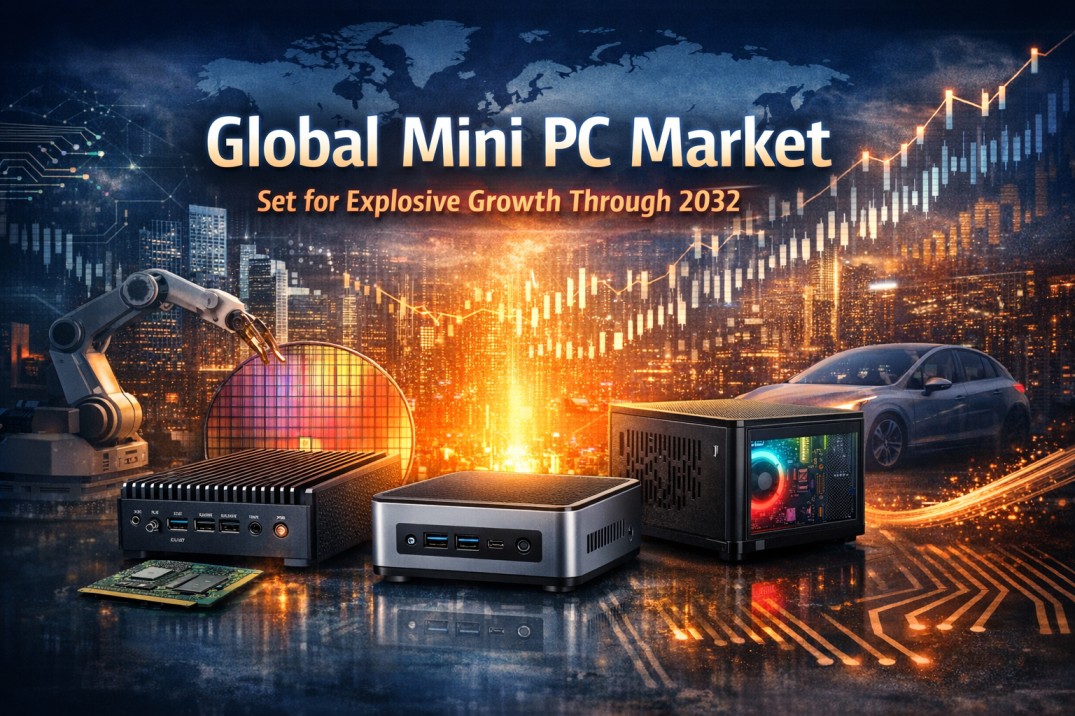
Segments | End-Use Applications | Regional Breakdown | March 2026 | Source: MRFR
Key Takeaways
- Mini PC Market projected to reach USD 9.2 billion by 2032 at an 11.8% CAGR.
- Enterprise fleet migration from legacy tower workstations is the single largest structural demand driver, delivering 61% footprint reduction and 38% energy savings per seat.
- Apple M-series, Intel NUC, and AMD Ryzen Embedded SoC platforms are closing the performance gap with tower workstations for the majority of professional workloads.
- Edge AI inference, digital signage, and home theatre computing represent the three fastest-growing non-enterprise application segments.
- Asia-Pacific leads manufacturing and consumer volume; North America and Europe dominate enterprise fleet and prosumer deployments.
The global mini PC market is projected to reach USD 9.2 billion by 2032 at an 11.8% CAGR, reflecting a structural shift in enterprise and prosumer computing toward space-efficient, low-power desktop systems without sacrificing performance. Powered by Intel NUC, AMD Ryzen Embedded, and Apple M-series SoC architectures, modern mini PCs deliver workstation-class performance in sub-litre enclosures — enabling thin-client enterprise deployments, digital signage control, home theatre computing, and edge AI inference at the point of need. Enterprise deployments replacing legacy tower workstations report 61% reductions in desktop footprint, 38% lower energy consumption per seat, and total cost of ownership parity within 24 months.
Market Size and Forecast (2024–2032)
| Metric | 2024 Value | 2032 Projected Value | CAGR |
| Mini PC Market | — | USD 9.2B | 11.8% |
Segment & Application Breakdown
| Application | Platform | Primary Use Case | Key Purchase Driver |
| Enterprise fleet | Intel NUC / AMD Ryzen Embedded | Productivity, analytics, communications | TCO, energy efficiency, footprint |
| Prosumer / creative | Apple Mac Mini (M-series) | Video editing, design, development | Unified memory, performance-per-watt |
| Digital signage | ARM / Intel Celeron SoC | Display control, kiosk, DOOH | Low power, managed deployment, and cost |
| Edge AI inference | AMD Ryzen AI / Intel Core Ultra | On-device AI processing, IoT analytics | NPU performance, connectivity, thermal |
→ Download Free Sample PDF — Mini PC Market
Includes market sizing, segmentation methodology, and regional forecast tables.
What Is Driving Mini PC Market Demand?
Enterprise compact compute migration: SoC performance convergence has made mini PCs viable replacements for legacy tower workstations across standard productivity, analytics, and communications workloads. Corporate sustainability mandates, hybrid work architecture redesigns, and data centre footprint reduction programmes are accelerating fleet migration programmes at scale.
Apple M-series SoC disruption: Apple’s M-series unified memory architecture has redefined performance-per-watt expectations in the mini PC category, triggering competitive responses from Intel and AMD and raising the bar for what buyers expect from sub-litre form factors. The Mac Mini M4 series has expanded mini PC adoption among creative professionals, developers, and prosumers who previously required tower workstations.
Edge AI and IoT inference demand: The proliferation of on-device AI workloads — real-time analytics, computer vision, natural language processing — is creating demand for NPU-integrated mini PC platforms capable of running inference locally without cloud round-trip latency. AMD Ryzen AI and Intel Core Ultra platforms with dedicated NPUs are the primary battleground for this emerging segment.
Digital signage and DOOH infrastructure expansion: The expanding digital out-of-home advertising market and enterprise digital signage network rollouts are generating scalable, cost-sensitive mini PC deployments where centralised device management, low power consumption, and compact display-side installation are the primary procurement criteria.
Regional Market Breakdown
| Region | Maturity | Key Drivers | Outlook |
| North America | Mature | Enterprise fleet migration, creative professional adoption, home theatre and prosumer segments | Steady, enterprise SoC refresh and edge AI expansion |
| Europe | Strong | EU energy efficiency mandates, GDPR thin-client compliance, enterprise sustainability procurement | Strong, compact compute and sustainability mandate alignment |
| Asia-Pacific | Dominant volume | China and Taiwan OEM manufacturing, Japan enterprise energy-efficient computing, India IT sector adoption | Highest volume; India and SE Asia enterprise segment accelerating |
| Middle East & Africa | Expanding | Smart city digital infrastructure, enterprise digital transformation, signage network rollouts | Strong; greenfield digital signage and enterprise deployments |
| Latin America | Emerging | Brazil and Mexico enterprise modernisation, cost-sensitive mid-range mini PC adoption | Moderate; cost-sensitive enterprise and signage growth |
Competitive Landscape
| Category | Key Players |
| Premium / Prosumer | Apple (Mac Mini M-series), Intel (NUC), ASUS (PN-series) |
| Enterprise / Commercial | Intel NUC Pro, HP Mini, Lenovo ThinkCentre Nano, Dell OptiPlex Micro |
| Value / Consumer | Beelink, MinisForum, GMKtec, Minix, ACEMAGIC |
| Signage / Embedded | Advantech, Kontron, Aaeon, OnLogic |
Outlook Through 2032
SoC performance convergence, edge AI demand, and enterprise energy efficiency mandates will sustain the mini PC market’s 11.8% CAGR through 2032. Vendors investing in NPU-integrated platforms, Thunderbolt 4/USB4 ecosystem depth, and enterprise fleet management software compatibility will capture the highest-value segments as mini PCs complete their transition from niche form factor to mainstream enterprise compute standard.
Access complete forecasts, segment analysis & competitive intelligence:
→ Purchase the Full Mini PC Market Report (2025–2032)
7-year forecasts | Segment & application analysis | Regional data | Competitive landscape | 150+ pages
Market data sourced from Market Research Future (MRFR). Published March 2026. For custom research enquiries, contact MRFR.